Talking to the top of a head
One ordinary evening, told by the clock, and the moment in it the research worries about most. A child speaks, and the parent's head is bent over a phone.
By Jugl Studio. 6 sources, listed at the end.
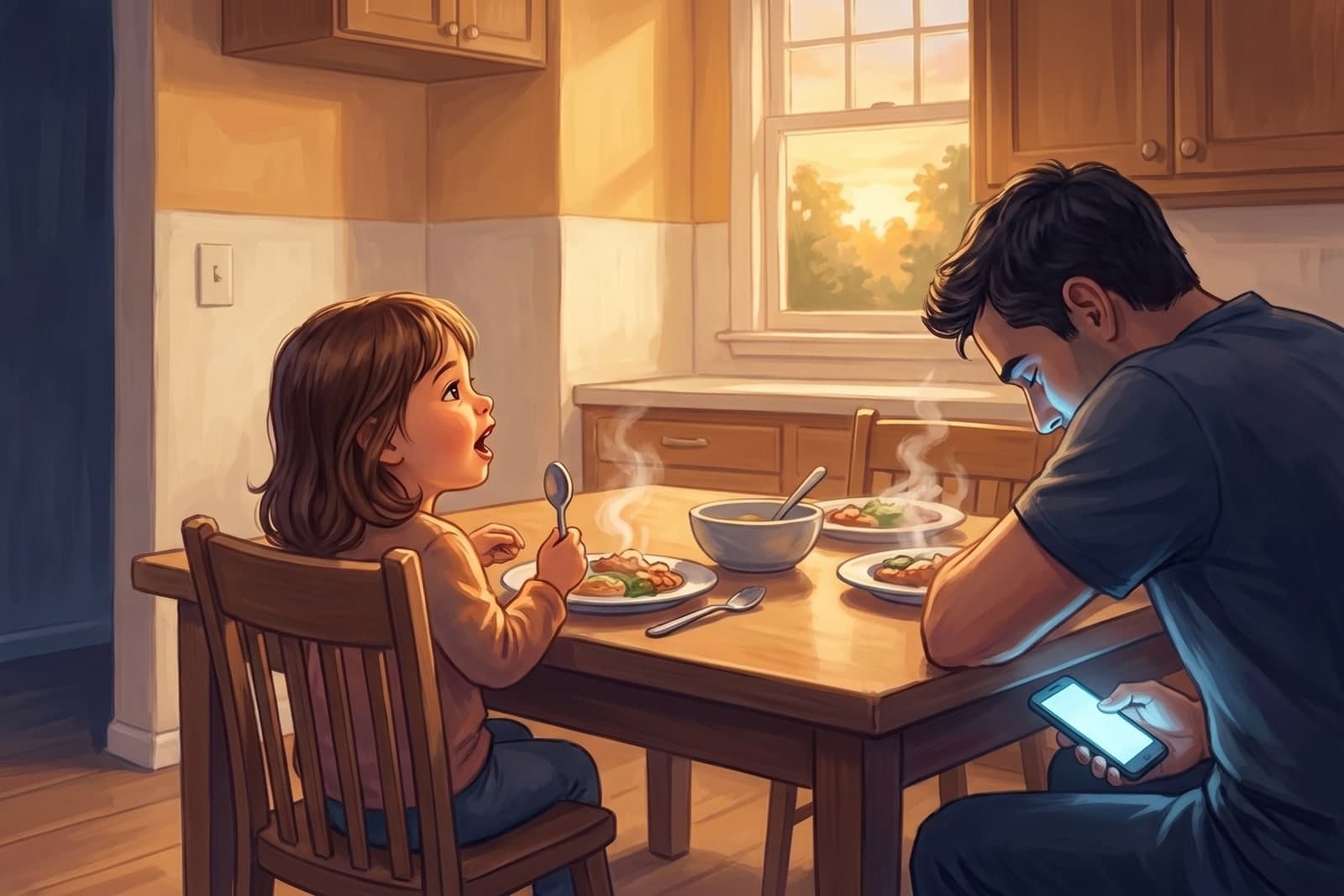
This note is about one moment. It lasts a few seconds and it happens in most homes most days. A child says something to a parent, and the parent's head is bent over a phone. The child is talking to hair and a forehead. Sometimes an answer comes. Sometimes it comes late, in a voice that was not really listening. Sometimes it does not come.
Researchers gave the moment a name in 2018. They called it technoference, technology interfering in the space between a parent and a child. We make comics and board games for tables, so we have spent a long time looking at this moment. Here is one evening, told by the clock, with the research beside it. Nothing in it is invented. Every figure is sourced at the end.
6:40 in the evening. Dinner.
She is three. She has a spoon in one hand and something to tell him about a dog she saw. He is reading a message under the edge of the table, the way people do when they know they should not be. This is the moment the study was about.
The researchers asked 170 American parents of children under six how often technology interrupted time with their child on a typical day. Nearly half said three or more times. About one in ten said never. Then they measured the children. More interruptions went along with more of the behaviour that wears parents down, the tantrums, the whining, the sulking and the hyperactivity. The study cannot prove which causes which, and the authors say so plainly. It can say the two travel together.
| Three or more times | 48% |
|---|---|
| Never | 11% |
170 American parents of children aged one to five. McDaniel and Radesky, Child Development, 2018. Source 1.
A child who is talking to the top of a bent head is learning how much they are worth an answer.
7:15 in the evening. The question nobody asks twice.
Ask a parent whether their phone gets between them and their child, and most will say not really. Ask the child, and you get a different number. Pew Research put the same question to American teenagers and their own parents in 2023. Nearly half of the teenagers said a parent is at least sometimes distracted by a phone when they are trying to talk to them. Under a third of the parents agreed. That gap is the whole problem in one chart. The person with the phone is the last to know.
| Teenagers say | 46% |
|---|---|
| Parents say | 31% |
1,453 American teenagers aged 13 to 17 and their parents, surveyed together. Pew Research Center, March 2024. Source 2.
The same survey found something quieter. Nearly four in ten teenagers said they spend too much time on their own phone. About three quarters said they often or sometimes feel happy, and peaceful, when they do not have it. The children are not the ones defending the phones. They would like the heads up too.
- 38%
- of teenagers say they spend too much time on their phone. Source 2.
- 74%
- often or sometimes feel happy when they do not have their phone. Source 2.
- 72%
- often or sometimes feel peaceful without it. Source 2.
8:00 in the evening. The sofa.
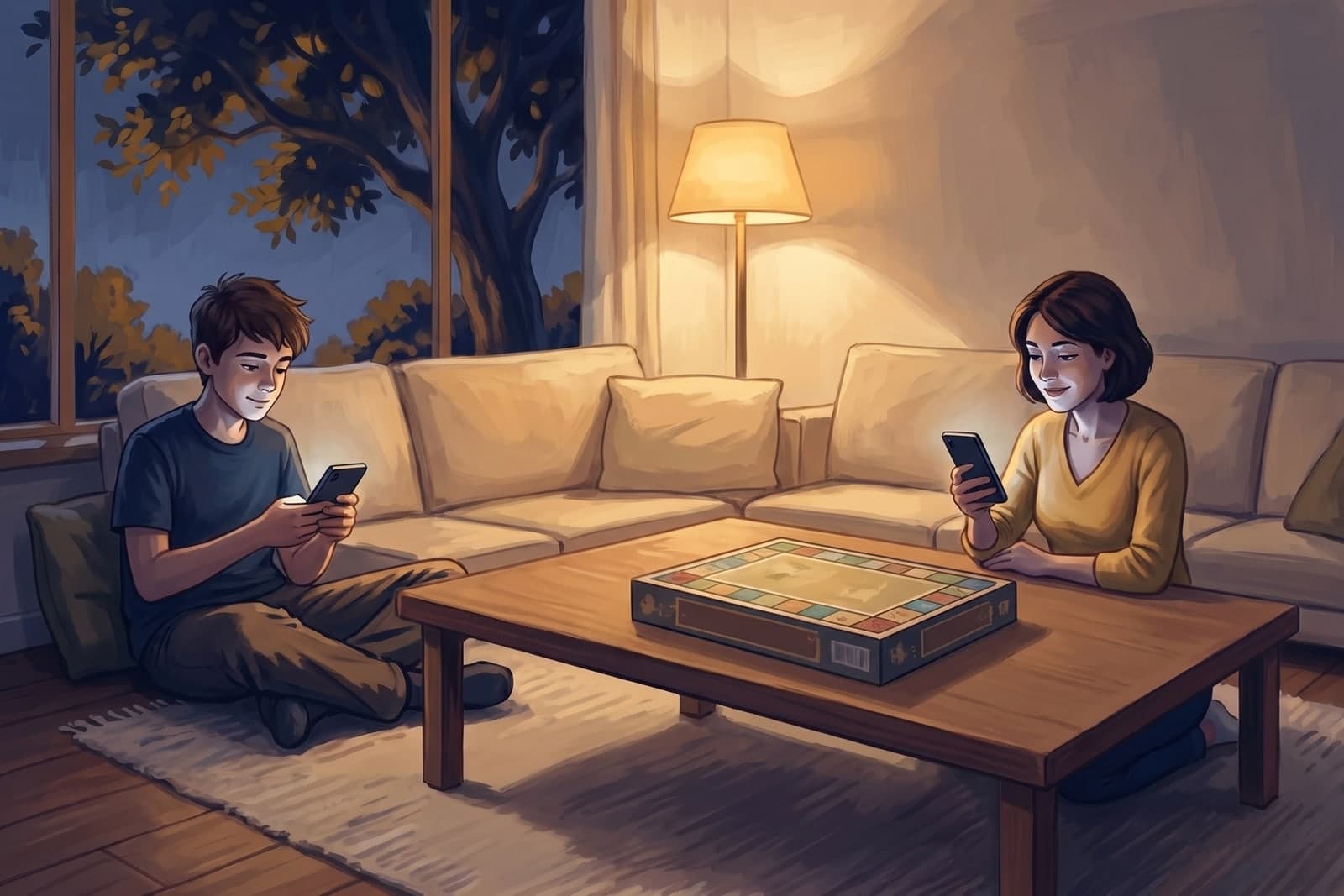
By now the moment has grown up. Nobody is talking to the top of anybody's head, because nobody is talking. Two people who love each other sit a cushion apart, each somewhere else. This is where the bent head at dinner leads, a few years on. In late 2024 Pew found that nearly half of American teenagers say they are online almost constantly. A decade earlier it was one in four.
| 2014 to 2015 | 24% |
|---|---|
| 2024 | 46% |
American teenagers aged 13 to 17. Pew Research Center, December 2024. Source 3.
And the table empties. The World Happiness Report went through twenty years of American time diaries. In 2023, one adult in four ate every meal of the day alone. That is up by more than half since 2003. Among people aged 25 to 34, the age of many new parents, it has risen by more than 180 percent. The people who will one day be the grandparents at the table are, right now, the people most often eating without anyone.
- 1 in 4
- American adults ate every meal alone on the day surveyed, 2023. Source 4.
- +50%
- rise in eating every meal alone since 2003, all adults. Source 4.
- +180%
- rise among adults aged 25 to 34 over the same twenty years. Source 4.
8:40 in the evening. What the meal was for.
It was never about the food. A 2023 review gathered 41 earlier reviews on family meals and read them together. Children and teenagers who eat with their families more often tend to show less depression, higher self-esteem and less disordered eating, and they describe their own family more warmly. These are associations, not promises. But they point the same way as the bent head does, from the other side. A meal with heads up is a place where a child finds out, night after night, that they are worth an answer.
9:05 in the evening. The bowl.
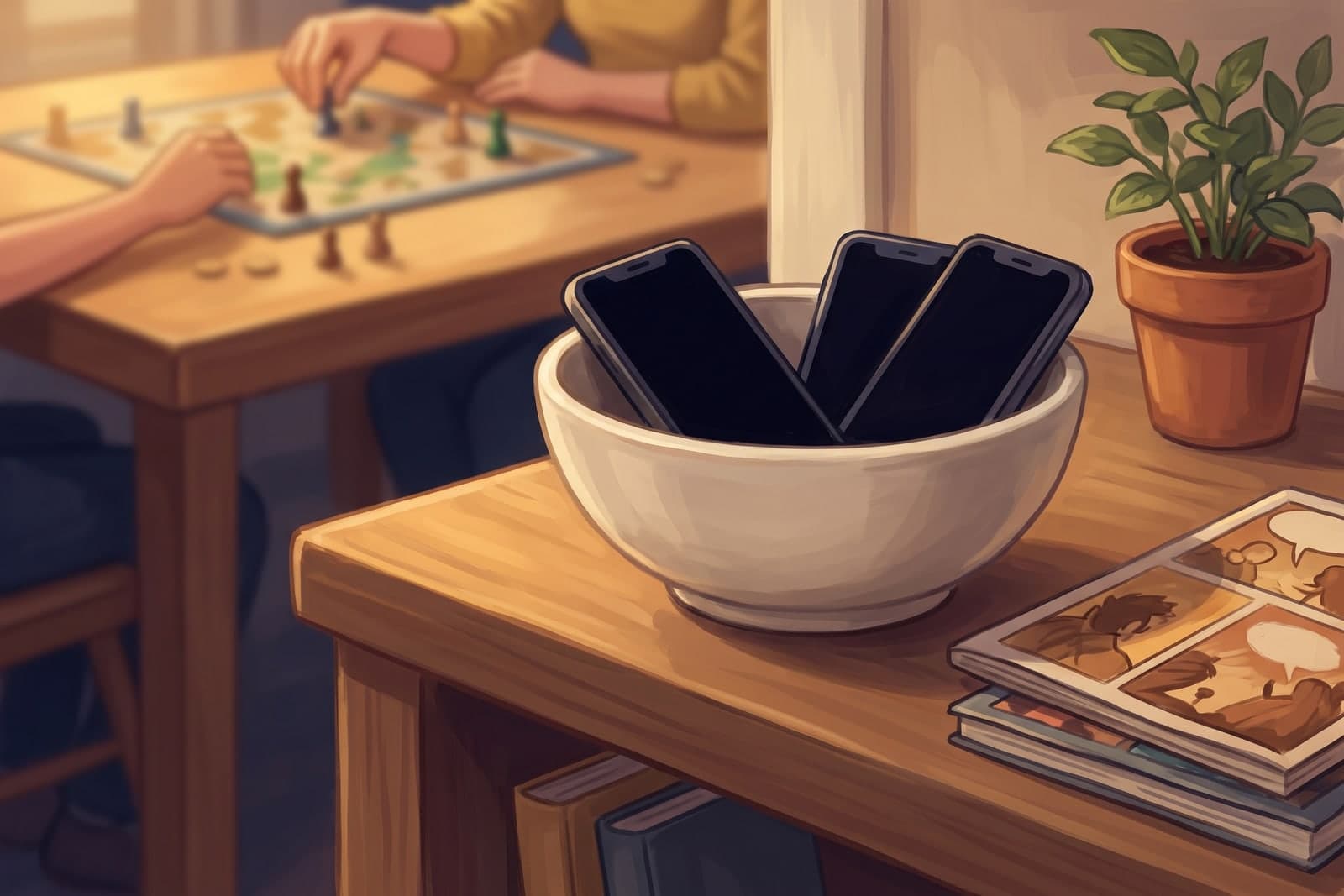
We promised this note would be about one moment, so it gets one piece of advice, and it is small. Put a bowl on a shelf and put the phones in it, face down, for the length of one meal or one game. Not the whole evening. Not forever. One meal. The child who was talking to the top of a head at 6:40 will notice before you do.
We are not doctors and we will not dress this up as treatment. It is a bowl. The research above says the moment matters. The bowl is the cheapest way we know to end it for an hour.
9:20 in the evening. A lap and a book.

This is the same child, an hour and a half later, and the head above her is up. A 2025 review looked at 28 studies covering almost 25,000 children and found that reading together at home was strongly linked with children's language development. It did not study screens at all. It studied a lap, a book and a finger on the page.
That is why this house makes what it makes. A comic read aloud needs two people looking at the same page. A board game needs everyone at the table, taking turns, and it ends at the same time for all of them. Two of our comics are finished and free to read tonight. The board game, ROWWARD, is on its way. None of it is medicine. All of it needs the phones in the bowl.
Sources
- McDaniel and Radesky, Technoference, Parent Distraction With Technology and Associations With Child Behavior Problems, Child Development (2018), open access at PubMed Central
- Pew Research Center, How Teens and Parents Approach Screen Time (March 2024)
- Pew Research Center, Teens, Social Media and Technology 2024 (December 2024)
- World Happiness Report 2025, Chapter 3, Sharing meals with others
- Snuggs and Harvey, Family Mealtimes, A Systematic Umbrella Review, Nutrients (2023)
- Galea and colleagues, home-based shared book reading and child development, Frontiers in Language Sciences (2025)